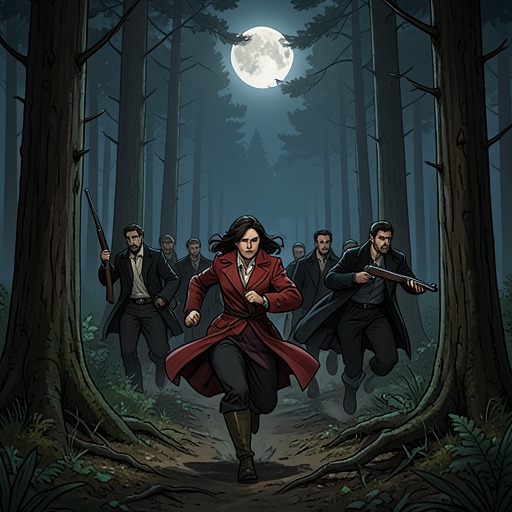
Sierra and Alan flee the Blue Blood Pack
Broken Rejected MateSierra and Alan flee the Blue Blood Pack after Sierra concludes that remaining at the pack house would expose both of them to unacceptable danger. The escape is not presented as cowardice but as a calculated withdrawal: Sierra cannot yet control most of her powers, Ronald Lowell is both strong and cunning, and the couple needs time to find a haven, recover their judgment, and decide how to respond. The journey therefore marks a tactical separation from the pack rather than an abandonment of their cause, even as it sharpens the conflict between Sierra’s caution and Alan’s desire to stand and fight.
Causes and Background
Sierra’s decision to leave is inseparable from the history attached to her identity. She is a Dysomnia wolf, a member of a nearly extinct lineage that has been hunted for centuries because other werewolves fear a repetition of an earlier catastrophe. According to Doherty Langford’s explanation, Dysomnias were once revered for their strength and intelligence, perhaps even treated as wolf royalty, before all of them became feral and killed other werewolves without reason. The old violence has become a justification for present persecution, so Sierra’s existence is treated as a latent danger rather than as the life of an individual daughter, mate, or pack member.
That classification follows Sierra into every supposedly ordinary space. At Domina High, a small school with fewer than a thousand students, she wants to disappear, yet she knows that some students are supposedly werewolves who would never accept her if they discovered what she was. Earlier, even the dogs stalking her react to her as though her presence carries an instinctive threat: they foam at the mouth, growl, and display both anger and fear before attacking. These episodes establish the atmosphere in which the later escape occurs. Sierra has spent her life moving through spaces where concealment is a condition of safety, and the Blue Blood Pack cannot fully erase the danger attached to her bloodline.
Her relationship with Alan Lowell complicates that defensive life. Sierra suspects that Alan may also be a werewolf and initially believes that, if he is, the responsible action would be to stay away from him. At the same time, she hopes he is not, because she already regards him as one of the best people she has met in a long time. Their closeness becomes a source of belonging, but it also gives Ronald Lowell a target through which Sierra can be threatened and Alan can be compelled to act.
Departure and Immediate Course
The immediate decision to leave comes after Alan is urged to protect his mate. Sierra suddenly enters the room and agrees that they need to go, cutting through the argument with a quiet directive rather than a dramatic confrontation. She and Alan follow the advice of Drew and Tony, leaving the pack house early in the morning, at the least suspicious time. They have no destination, only the knowledge that they need a temporary haven.
Their preparations are intentionally limited. They pack a few clothes and some food, get into Alan’s car, and drive away. The lack of a settled destination emphasizes both the urgency of the departure and its provisional nature. They are not beginning a new life elsewhere; they are creating enough distance to collect their thoughts and plot their next course of action. Flight becomes a pause in the larger struggle, a way to preserve the possibility of returning on better terms.
Sierra explicitly frames the choice as reasoned self-preservation. She argues that she can barely use most of her powers and that Ronald would certainly have prepared for the possibility of her using them. A fight under those conditions could injure either member of the couple. Her reasoning rejects the romantic image of bravery as standing still until violence arrives. In Sierra’s formulation, running away is not the coward’s way out but the logical way out. The phrase gives the action an ethical and strategic vocabulary: survival protects the future in which resistance may still be possible.
Conflict Between Sierra and Alan
The escape does not immediately produce unity. Alan becomes nearly silent, speaking fewer than five sentences to Sierra after the previous day, and the silence itself becomes another form of pressure inside the moving car. When they stop for lunch and eat take-out from a restaurant, Sierra asks him to talk because the silent treatment is making the situation worse. His restrained withdrawal turns the physical journey into a relational impasse.
Alan’s response exposes the value conflict beneath the escape. He condemns the choice to run because Sierra is one of the most powerful werewolves in existence, and he sees their departure as a refusal to stand their ground. His anger is intensified by the belief that strength carries an obligation to confront the enemy directly. Sierra, however, measures power against control. Possessing extraordinary abilities does not mean that she can safely deploy them, particularly against an opponent who has anticipated her possible methods.
Sierra answers by separating courage from recklessness. She acknowledges Alan’s pain and sense of betrayal, but insists that the decision was the safest and smartest option. If they had stayed, either of them could have been hurt. She also refuses to let Alan turn anger into isolation, reminding him that they are partners and promising that revenge can come later, after immediate safety has been secured. The exchange preserves the couple’s shared objective while exposing their incompatible responses to danger: Alan moves toward confrontation, whereas Sierra attempts to protect their future by delaying it.
Pursuit and Consequences
The escape fails to provide complete security. Alan notices a vehicle that may have been present roughly twenty minutes earlier, when they arrived at the restaurant, and tells Sierra that he thinks they have been followed. Sierra responds with bitter sarcasm, recognizing that the danger has crossed the boundary of the pack house and entered their attempted refuge. Alan starts the car and considers trying to lose the follower, so the journey shifts again—from departure, to argument, to active evasion.
This pursuit demonstrates why Sierra’s caution is justified without making the escape futile. Leaving the pack has created distance, but it has not ended Ronald’s reach or removed the threat connected to Sierra’s identity. The couple gains temporary mobility rather than safety. Their freedom is conditional, dependent on concealment, speed, and the ability to choose a defensible haven before their pursuers close in.
The action also intensifies Sierra’s transformation from a hidden girl into a hunted supernatural figure whose reputation precedes her. When she introduces herself to Charlie, his widened green eyes immediately identify her as the girl who killed a hunter. His recognition shows that concealment is becoming increasingly difficult: Sierra is no longer merely protecting a private secret, but carrying a public history of violence that others use to classify her. The escape thus follows a broader pattern in which attempts to remain invisible are repeatedly defeated by bloodline, reputation, and the political fear surrounding Dysomnias.
Narrative Significance
Sierra and Alan’s flight gives physical form to the book’s recurring opposition between attachment and danger. Sierra has learned to survive by hiding, moving on, and refusing to let others become responsible for saving her; her father’s repeated protection has made her uneasy about placing him in that position. With Alan, she tries to replace solitary flight with partnership. She does not leave alone, and she does not abandon the promise of eventual revenge. Instead, she asks Alan to understand that protecting one another sometimes requires retreat.
The episode also turns an apparent loss into a strategic value shift. The couple leaves the pack house under threat, with no destination and with Alan emotionally withdrawn, so departure initially looks like weakness and fracture. Yet the act preserves both lives, creates time for planning, and keeps Sierra from being forced into an uncontrolled use of her powers. Its later discovery that they have been followed prevents any easy victory: flight is sensible, but it is not sufficient. The escape matters because it establishes the couple’s survival as an active choice while carrying them toward the next confrontation rather than away from the story’s central conflict.